
A detailed article about Socrates, the Brazilian midfield legend remembered for intelligence, elegance, leadership, technical brilliance, and his influence far beyond football.
Socrates Brasileiro Sampaio de Souza Vieira de Oliveira was born in Belém, Brazil, in 1954. Better known simply as Socrates, he followed a path that was very different from that of most professional footballers. Education remained important throughout his youth, and he eventually studied medicine while developing his football career. This combination of academic achievement and sporting excellence contributed to the unique reputation that surrounded him throughout his life.
Rather than entering professional football at an extremely young age, Socrates balanced his studies with the development of his sporting talent. His intelligence was visible on the pitch as clearly as it was away from football. He understood space, movement, and tactical situations exceptionally well. Although he was tall and physically distinctive, his game depended primarily on technique, anticipation, and creativity.
The professional career of Socrates began with Botafogo de Ribeirão Preto, commonly known as Botafogo-SP. It was there that his unusual combination of size and technical quality began attracting wider attention. He was capable of controlling midfield while also moving into advanced positions and scoring goals.
His performances demonstrated that he was far more than a conventional central midfielder. Socrates could dictate the rhythm of a match, create opportunities with clever passes, and arrive inside the penalty area at exactly the right moment. His intelligence allowed him to make difficult football appear remarkably simple.
In 1978, Socrates joined Corinthians and entered the most important period of his club career. He became a central figure at one of the biggest clubs in Brazil and developed a powerful connection with the supporters. His elegant style, leadership, and personality made him much more than another talented player.
On the field, Socrates became the creative leader of the team. He was famous for his vision and his ability to execute backheel passes with extraordinary precision. While many players used such techniques primarily for entertainment, Socrates used them as effective tactical tools. A perfectly timed backheel could release a teammate without forcing him to turn or interrupt the speed of an attack.
He helped Corinthians win important regional titles and became one of the defining players in club history. His influence, however, extended far beyond results and trophies.
One of the most remarkable chapters in the life of Socrates was his involvement in Corinthians Democracy. During the early 1980s, players and staff at Corinthians promoted a system in which important club decisions were discussed and voted upon collectively. The movement developed during the final years of military rule in Brazil and acquired significance beyond football.
Socrates became one of its most recognisable figures. He was articulate, politically engaged, and willing to use his public profile to discuss democracy and social issues. This made him an unusual sporting figure. He was simultaneously one of the finest footballers in the country, a qualified doctor, and a prominent voice in public debate.
For many football supporters, Socrates is most closely associated with the Brazil team that competed at the 1982 FIFA World Cup in Spain. Coached by Telê Santana, the side included extraordinary players such as Zico, Falcão, Éder, and Junior. Socrates served as captain and represented the intelligence and freedom that defined the team.
Brazil played adventurous attacking football built around technical quality, passing, and movement. Socrates was essential to the system. He could receive the ball under pressure, move attacks forward, and contribute goals from midfield. His famous goal against the Soviet Union demonstrated his ability to strike powerfully from distance, while his finish against Italy showed composure in one of the most important matches of the tournament.
Brazil eventually lost 3-2 to Italy in a legendary encounter that eliminated the team from the competition. Despite failing to win the World Cup, the 1982 side became one of the most celebrated teams in football history. Socrates remained one of its defining symbols.
Socrates returned for the 1986 World Cup in Mexico. Brazil again possessed considerable talent and reached the quarterfinals, where France provided the opposition in one of the finest matches of the tournament. After a 1-1 draw, the contest was decided by a penalty shootout.
Socrates missed his penalty as France eventually advanced. It was a painful conclusion, but it did little to diminish his international reputation. Across his years with the national team, he demonstrated creativity, leadership, and an understanding of attacking football that made him one of the most admired midfielders of his generation.
The style of Socrates was instantly recognisable. Standing well over six feet tall, he did not have the typical physical profile associated with an elegant playmaker. Nevertheless, his touch was exceptionally delicate, and his ability to manipulate the ball in confined spaces made him difficult to contain.
His passing was particularly impressive. Socrates often seemed to know where teammates were positioned before receiving the ball. This awareness allowed him to play quickly and avoid unnecessary touches. His famous use of the backheel reflected this understanding of space rather than a desire simply to produce spectacular moments.
He was also a considerable scoring threat. Socrates could shoot from distance, finish inside the area, take penalties, and move intelligently beyond forwards. This combination of creativity and scoring ability made him a complete attacking midfielder.
After becoming a major star in Brazil, Socrates moved to Fiorentina in 1984. Serie A was one of the strongest and most tactically demanding leagues in the world at the time. His experience in Italy lasted only one season, and he never became as influential there as he had been at Corinthians.
The structured nature of Italian football provided a considerable contrast with the freedom he had enjoyed in Brazil. He later returned home and represented clubs including Flamengo and Santos before eventually ending his professional career.
The nickname Doctor Socrates was unusually appropriate. He completed his medical education and remained interested in medicine, politics, philosophy, music, and social questions. Football was a major part of his identity, but it never represented the entirety of his intellectual life.
This distinguished him from almost every other superstar of his generation. Interviews with Socrates frequently moved beyond matches and tactics into discussions about Brazilian society and culture. His willingness to express complex ideas contributed to an image that remains unique in football history.
Socrates never won the World Cup, but major trophies alone cannot measure his influence. He became one of the most recognisable representatives of a philosophy in which football was supposed to combine intelligence, creativity, technical excellence, and freedom.
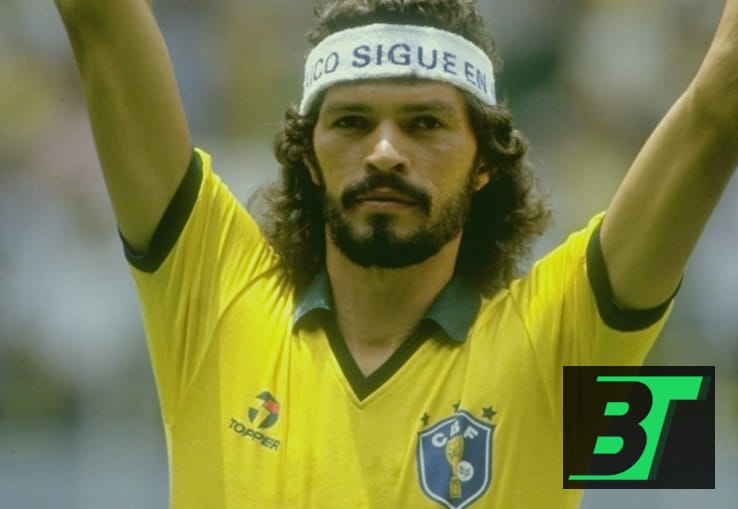
The Brazil team of 1982 remains central to that legacy. It demonstrated that a team could become historically important even without winning the tournament. Socrates, with his beard, headband, upright running style, and remarkable technical ability, became the visual and intellectual leader of that unforgettable side.
His influence at Corinthians was equally important. Supporters remember not only the goals and passes but also the leadership he provided during a significant period in the history of the club and the country.
Socrates occupies a distinctive place among the greatest players in football history. He was an elegant midfielder capable of controlling matches through intelligence, vision, and technique, but his importance reached much further. His medical education, political engagement, and leadership made him one of the most fascinating personalities ever associated with the sport.
From Corinthians to the Brazilian national team, Socrates played football with imagination and purpose. He captained one of the most admired teams ever to appear at a World Cup and helped demonstrate that beauty and creativity could be as memorable as trophies. Decades later, the Doctor remains a symbol of intelligent football and independent thought, ensuring that the name Socrates continues to hold a special place in the history of the game.