
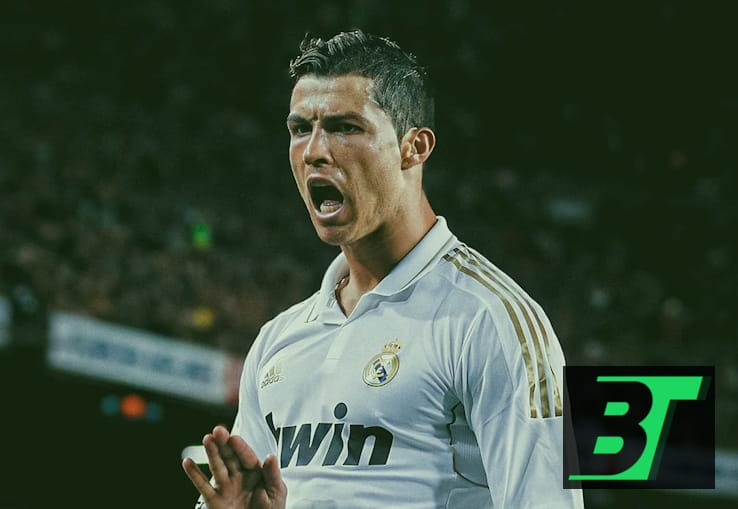
A detailed article about Cristiano Ronaldo, the Portuguese football legend whose goals, athleticism, determination, and record-breaking career made him one of the greatest players of all time.
Cristiano Ronaldo dos Santos Aveiro was born in Funchal, Madeira, Portugal, in 1985. He grew up in a modest family and developed an intense passion for football from an early age. The ball quickly became the centre of his life, and his natural speed, coordination, and determination separated him from other young players. After beginning with local club Andorinha and later Nacional, his ability attracted the attention of Sporting CP, one of the leading academies in Portuguese football.
Moving from Madeira to Lisbon while still a child required considerable sacrifice. Ronaldo was separated from his family and had to adapt to a completely different environment. Those early difficulties helped develop the competitive mentality that would become one of the defining characteristics of his career. At Sporting, he progressed rapidly through the youth levels before reaching the senior team.
Ronaldo attracted international attention after an impressive performance against Manchester United in a friendly in 2003. Shortly afterwards, Sir Alex Ferguson brought the young Portuguese winger to Old Trafford. He arrived as an exciting but relatively inexperienced teenager, famous for quick feet, stepovers, and fearless attacking runs.
During his first seasons in England, Ronaldo gradually transformed his game. He became stronger, improved his decision making, and developed into a much more complete attacking player. His ability to score from distance, attack crosses, take free kicks, and beat defenders made him increasingly difficult to contain.
The transformation reached its peak during the 2007-08 season. Ronaldo scored 42 goals in all competitions as Manchester United won the Premier League and UEFA Champions League. His performances earned him the 2008 Ballon d Or and established him as one of the leading players in world football.
In 2009, Ronaldo moved to Real Madrid in one of the most significant transfers in football history. Expectations were enormous, but his goalscoring output in Spain exceeded almost every prediction. He developed from a winger into an extraordinary scoring machine capable of deciding matches from almost any attacking position.
Ronaldo scored 450 competitive goals in 438 appearances for Real Madrid, becoming the leading scorer in club history. He repeatedly surpassed 40 and 50 goals in a season and produced decisive performances in La Liga and the Champions League.
European competition became a particularly important part of his Madrid legacy. Ronaldo helped Real Madrid win four Champions League titles during his time at the club, including three consecutive triumphs between 2016 and 2018. His goals in knockout matches became a defining feature of that period. Whether through headers, penalties, counterattacks, or spectacular finishes, he consistently delivered when the pressure was greatest.
Much of the Ronaldo era at Real Madrid coincided with Lionel Messi playing for Barcelona. Their competition created one of the greatest individual rivalries football has ever witnessed. El Clasico became an even larger global event as supporters debated which player deserved to be considered the best in the world.
The contrast between them made the rivalry particularly fascinating. Messi was celebrated for close control, creativity, and natural playmaking ability, while Ronaldo became associated with explosive athleticism, movement, aerial ability, and relentless goalscoring. Both continually raised their standards, contributing to an extraordinary period in Spanish and European football.
Ronaldo made his senior debut for Portugal in 2003 and gradually became the central figure of the national team. He represented the country at numerous European Championships and World Cups, eventually becoming captain and one of the most prolific scorers in international football history.
The greatest moment came at Euro 2016. Portugal reached the final against France, but Ronaldo suffered an injury during the first half and was forced to leave the pitch. He remained beside the technical area encouraging his teammates as Portugal secured a historic 1-0 victory after extra time. The triumph delivered the first major senior international trophy in Portuguese football history.
Portugal added another international title by winning the inaugural UEFA Nations League in 2019. These achievements strengthened the international legacy of Ronaldo and answered one of the major questions that had surrounded his career during his earlier years.
After nine extraordinary seasons in Madrid, Ronaldo joined Juventus in 2018. Moving to Serie A provided a new challenge at a stage when many players would already have been approaching the end of elite competition. Instead, Ronaldo continued scoring at an exceptional rate.
He helped Juventus win consecutive Serie A championships and collected individual scoring honours in Italy. His ability to remain productive across the Premier League, La Liga, and Serie A demonstrated remarkable adaptability. Different tactical environments required adjustments, but his movement and finishing continued to produce goals.
Ronaldo returned to Manchester United in 2021, nearly two decades after first arriving in England. His second spell included several memorable performances and another productive scoring season, although the club was going through a difficult period of transition.
After leaving Manchester United, Ronaldo joined Al Nassr in Saudi Arabia at the end of 2022. The move became an important moment for football in the region. Other internationally recognised players subsequently moved to Saudi clubs, increasing global interest in the domestic competition. Even at an age when most elite forwards have retired, Ronaldo continued to pursue goals and records.
One of the most impressive aspects of the career of Cristiano Ronaldo has been his ability to evolve. The young player at Sporting and Manchester United was primarily an explosive winger who wanted to attack defenders directly. Over time, he became a more efficient forward focused on movement, positioning, and finishing.
His aerial ability has been particularly remarkable. Powerful jumping, timing, and body control allowed him to score headers against much taller defenders. Combined with exceptional physical preparation, these qualities helped extend his career at the highest level.
Ronaldo also became famous for an intense approach to training. Fitness, recovery, nutrition, and repetition formed important parts of his professional routine. Natural ability provided the foundation, but constant improvement allowed him to remain competitive across different generations of football.
Few football careers can match the collection of records achieved by Ronaldo. He has won multiple Ballon d Or awards, finished as leading scorer in major competitions, and reached extraordinary totals for both club and country. He also became the first male player to score at five different World Cups.
Statistics alone, however, do not fully explain his impact. Ronaldo repeatedly produced important goals in decisive matches. Champions League knockout rounds, international tournaments, league title races, and major finals provided the stage for many of his most memorable performances.
Ronaldo became much more than a successful footballer. His worldwide popularity helped transform him into one of the most recognisable athletes of the modern era. Supporters from Europe, Asia, Africa, the Americas, and the Middle East followed his career, while his famous number 7 became closely connected with his personal identity.
His influence also reached younger players. Many modern forwards have studied his movement, finishing, training habits, and ability to reinvent himself. For aspiring footballers, his career provides an example of how talent can be combined with extraordinary ambition and discipline.
Cristiano Ronaldo has secured a permanent place among the greatest players in football history. His achievements across Portugal, England, Spain, Italy, and international football demonstrate an exceptional ability to adapt and succeed. Few players have maintained such high standards for such a long period.
Debates about the greatest footballer of all time will continue because different generations produced extraordinary players with very different qualities. What cannot reasonably be disputed is the scale of the Ronaldo career. The goals, trophies, records, longevity, and decisive performances place him within the smallest group of players who changed expectations of what an individual footballer could achieve.
The career of Cristiano Ronaldo represents ambition, evolution, and an extraordinary desire to compete. From a talented child in Madeira to a global football icon, he continually adapted his game while maintaining an exceptional ability to score goals. Manchester United helped transform him into a superstar, Real Madrid provided the stage for his most prolific years, Juventus demonstrated his adaptability, and Portugal gave him the opportunity to become a national champion.
His combination of athleticism, technical quality, mental strength, and longevity created a career unlike almost any other. Long after his final professional match, Cristiano Ronaldo will remain a reference point for goalscoring excellence and competitive determination. His place among the defining figures in the history of football is firmly established.