
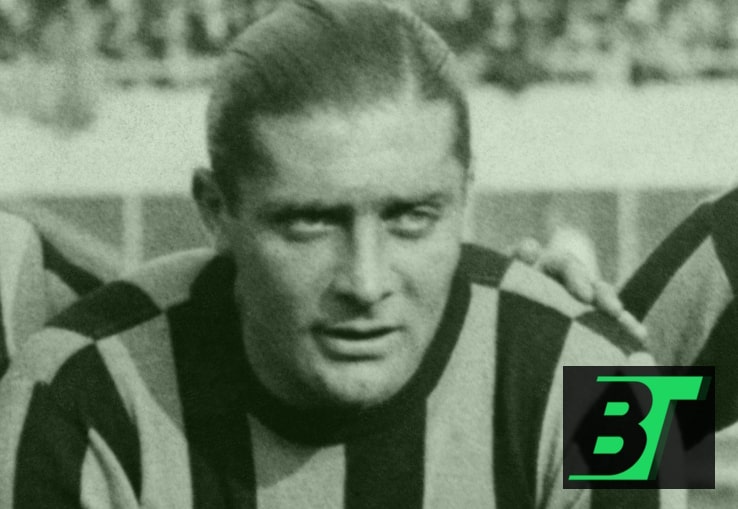
A complete look at Giuseppe Meazza, the Italian legend whose elegance, skill, and goals defined an era of football greatness.
Giuseppe Meazza was born in Milan in 1910, during a time when football was beginning to capture the hearts of Italians. Losing his father at a young age, Meazza’s mother raised him with limited means, but his love for football was unstoppable. He played barefoot in the streets of Milan, using makeshift balls, and his natural ability quickly became evident. By his teenage years, his extraordinary dribbling and goal-scoring instinct caught the attention of local scouts, and soon he was signed by Internazionale Milano, where his journey to greatness began.
Meazza made his debut for Inter (then known as Ambrosiana-Inter) at just 17 years old, scoring twice in his first match. His immediate impact was undeniable, and within a few seasons, he was the star of Italian football. Meazza’s technique, balance, and intelligence made him stand out. He possessed an almost effortless control of the ball, a sharp eye for goal, and the creativity to make his teammates better. He led Inter to multiple Serie A titles and became a symbol of excellence for the club. During the 1930s, he was not only Italy’s top scorer but also one of Europe’s most admired forwards.
Meazza’s influence extended far beyond club football. As a key player for the Italian national team, he helped guide Italy to two consecutive FIFA World Cup victories, in 1934 and 1938. Under coach Vittorio Pozzo, Meazza’s leadership and technical brilliance were essential. His ability to control games from midfield or lead the line as a striker gave Italy tactical flexibility. In the 1938 tournament, Meazza famously scored the decisive penalty in the semifinal against Brazil while holding up his shorts after the waistband snapped — a moment that perfectly symbolized his confidence and flair under pressure.
Giuseppe Meazza was more than just a footballer; he was a performer who brought elegance and style to the game. He was known for his dribbling artistry, quick thinking, and clinical finishing. Unlike many players of his time, Meazza had a showman’s touch, playing with joy and creativity that thrilled fans across Italy. Off the pitch, his charm and confidence made him a national celebrity. He was admired by supporters of all clubs and remains one of the few players who transcended football to become a cultural icon during pre-war Italy.
After his glorious years with Inter, Meazza played for AC Milan, Juventus, and Atalanta before returning to Inter to end his playing career. His versatility allowed him to adapt as he grew older, often taking on a deeper playmaking role while still showcasing his intelligence and vision. By the time he retired, he had scored over 500 goals in official and friendly matches combined, an extraordinary record for his era. His name became synonymous with Italian football excellence, and in recognition of his legacy, Inter Milan and AC Milan jointly named their shared stadium the Stadio Giuseppe Meazza — a rare honor in world football.
Following his retirement, Meazza remained active in football, serving as a coach and mentor to younger players. His deep understanding of the game made him an influential figure in the post-war development of Italian football. He worked with the national team and with Inter’s youth academy, ensuring that his experience benefited future generations. His emphasis on technique and creativity continued to shape Italian football philosophy long after his playing days ended.
Giuseppe Meazza’s name stands among the greatest in football history. He was Italy’s first true superstar, combining artistry, intelligence, and determination in a way that inspired millions. His contributions to both club and country helped lay the foundations for Italy’s footballing heritage. Decades after his passing in 1979, Meazza remains a symbol of elegance and excellence, a player who defined an era and whose legacy continues to shine brightly in the world of football.