
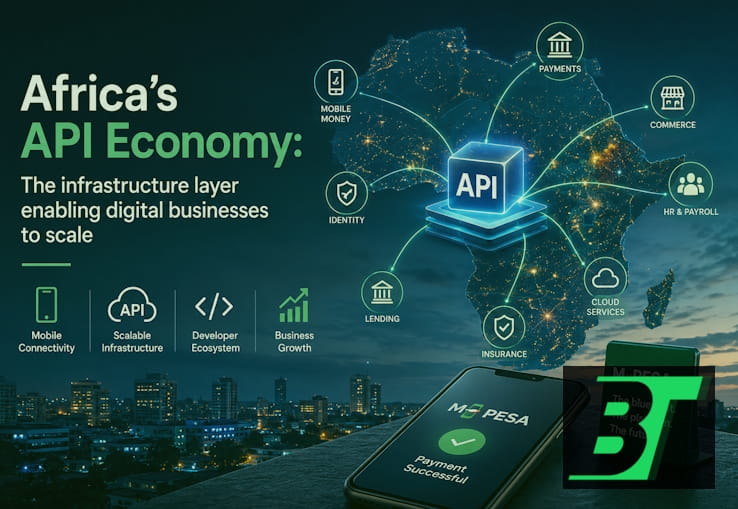
Discover how Africa's API economy is powering digital business growth, with scalable infrastructure, mobile connectivity, and platforms inspired by the success of M-Pesa.
Mobile internet adoption across sub-Saharan Africa has consistently outpaced predictions. Kenya passed 60% mobile penetration years ahead of analyst forecasts. Nigeria's active internet users crossed 100 million. Ethiopia, Tanzania, and Ghana are on similar trajectories. What has followed is a wave of B2B infrastructure investment aimed at giving the businesses built on top of this connectivity the same kind of functional APIs that digital businesses in Europe and North America have taken for granted for over a decade.
The clearest example of what purpose-built infrastructure can achieve in Africa remains M-Pesa. When Safaricom launched the service in Kenya in 2007, mobile money was a new concept. By 2023, M-Pesa was processing the equivalent of roughly half of Kenya's GDP in annual transaction value, and its API layer had become the foundation on which thousands of third-party applications were built — from micro-lending platforms to school fee collection systems.
The principle M-Pesa demonstrated is the same one powering the current wave of African B2B infrastructure investment: when you build a reliable, accessible API layer for a service that many businesses need, you create a platform that compounds in value as more builders adopt it. Safaricom's annual reports document how the M-Pesa API has become one of its most strategically important assets — not the product itself, but the programmable access to it.
The current generation of African fintech is going further. Companies like Flutterwave, Paystack, and Chipper Cash have built payment infrastructure APIs designed to work across multiple African jurisdictions simultaneously — solving the cross-border payment problem that has historically made it expensive and technically complex to run a pan-African digital business. Stripe's $200 million acquisition of Paystack in 2020 was an explicit bet on the value of that infrastructure layer.
For a business launching a digital product in Nigeria, Kenya, or Ghana today, the payment infrastructure question that would have required months of bank integrations a decade ago can now be resolved with a few lines of API code. The effect on market entry costs — and therefore on who can afford to build a competitive digital product — has been significant.
The API-first model is now reaching sectors beyond payments. In logistics, companies like Sendy and Kobo360 have built API layers that let e-commerce businesses access freight capacity across East and West Africa without managing their own vehicle fleets. In health, electronic medical records platforms are beginning to expose APIs that connect diagnostics labs, pharmacies, and insurance providers in ways that reduce the administrative overhead of healthcare delivery.
In sports wagering — one of East Africa's most active digital sectors — operators building competitive products for the Kenyan market have moved toward the same model. Rather than building proprietary data and pricing infrastructure from scratch, they access B2B sports betting API platforms that provide real-time odds, risk management, and payment gateway connections as integrated services. The Betting Control and Licensing Board in Kenya reports over 80 licensed operators — a market that would not have grown at this pace without accessible B2B infrastructure lowering the technical barrier to entry.
Despite the progress, significant gaps remain. Cross-border data regulations, inconsistent broadband infrastructure outside major urban centres, and the fragmentation of mobile money standards across different operators create friction that no single API can fully resolve. The next generation of African B2B infrastructure investment will need to address interoperability at a regional level — not just within individual countries.
The trajectory, however, is clear. The businesses that will define Africa's digital economy in 2030 are being built today on top of API infrastructure that is improving faster than almost any comparable market in the world.