
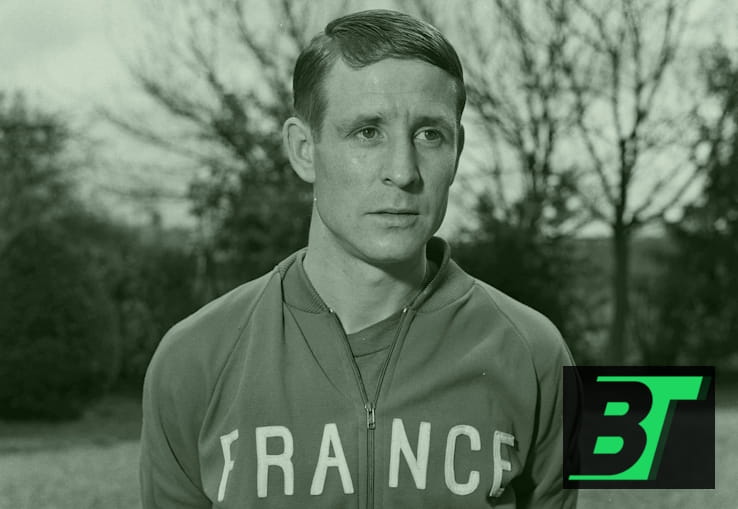
A detailed article about Raymond Kopa, the French football legend whose creativity, dribbling, vision, and success with Real Madrid made him one of the greatest players of his generation.
Raymond Kopa was born Raymond Kopaszewski in Noeux-les-Mines, France, in 1931. He came from a family of Polish immigrants and grew up in a mining community in northern France. His early life was very different from the glamorous football career that would eventually follow. Like many young men in the region, Kopa worked in the coal mines while still a teenager. A serious accident resulted in the loss of part of a finger, but it also contributed to his departure from mining and allowed him to focus more seriously on football.
Kopa was relatively small, but his size never prevented him from dominating matches. He developed exceptional balance, acceleration, close control, and an ability to change direction quickly. These qualities made him extremely difficult for defenders to contain. His intelligence was equally important. Kopa understood how to find space between defensive lines and knew when to dribble, pass, or move into a scoring position.
The professional journey of Kopa began with Angers, where his technical ability quickly attracted attention. French football was becoming increasingly competitive, and Kopa stood out because he offered something different. He was not simply a traditional forward waiting for opportunities near goal. He moved freely, collected the ball in deeper areas, challenged defenders, and created chances for teammates.
His performances convinced Stade de Reims to sign him in 1951. The transfer proved decisive because Reims was developing into one of the strongest clubs in European football. Surrounded by talented teammates and working within an ambitious system, Kopa was given the environment required to develop into an international star.
At Reims, Kopa established himself as one of the finest attacking players in France. He could operate as an inside forward, attacking midfielder, or deeper creative player. His dribbling allowed him to escape tight situations, while his passing regularly opened defensive structures. He also contributed important goals and became central to the attacking identity of the team.
Reims won major domestic honours during this period and emerged as a serious European force. The club reached the first European Cup final in 1956, facing Real Madrid in Paris. Reims produced an impressive performance and led during the match, but Real Madrid eventually won 4-3. Despite the defeat, Kopa had demonstrated his quality against the strongest club side in Europe.
Real Madrid signed Kopa in 1956, placing him alongside extraordinary players such as Alfredo Di Stefano, Paco Gento, and later Ferenc Puskas. Joining a team filled with established stars required adaptation, but Kopa had the technical intelligence to succeed. He became an important component of a side that dominated European football.
Kopa won three consecutive European Cups with Real Madrid in 1957, 1958, and 1959. He also helped the club win Spanish league titles. His role required versatility because Di Stefano occupied a central position in the attacking structure. Kopa frequently operated from wider areas, but his freedom of movement allowed him to influence matches throughout the final third.
His success in Madrid also had wider significance for French football. At a time when relatively few French players became major stars abroad, Kopa demonstrated that a player developed in France could become an essential figure at the most successful club in Europe.
The individual peak of the career of Kopa arrived in 1958 when he won the Ballon d Or. The award recognised his performances for both Real Madrid and France and confirmed his position among the elite players of the era. He became the first French footballer to receive the prestigious honour.
Winning the Ballon d Or was particularly significant because Kopa competed during a period featuring some remarkable attacking talent. His victory reflected more than goals or trophies. It recognised his creativity, influence, technical ability, and capacity to make teams function more effectively.
Kopa was also one of the defining players of the French national team during the 1950s. He represented France at the 1954 and 1958 World Cups, with the latter tournament producing the finest international achievement of his career.
France reached the semifinals of the 1958 World Cup in Sweden before losing to the eventual champions, Brazil. The French attack featured Kopa alongside prolific striker Just Fontaine, who scored a record 13 goals during the tournament. Kopa supplied creativity and movement behind the attack, helping Fontaine exploit spaces near goal.
France eventually finished third, an excellent achievement for the national team at the time. Kopa was recognised as one of the outstanding performers of the competition and strengthened his reputation as one of the finest creative players in world football.
After three highly successful seasons in Spain, Kopa returned to Stade de Reims in 1959. Rather than treating the move as the beginning of a decline, he continued performing at an excellent level. His experience at Real Madrid had made him an even more intelligent player, and he helped Reims secure further success in French football.
The return also reinforced the close connection between Kopa and the club where he had first become a major star. He remained with Reims for the rest of his professional playing career, eventually retiring in 1967.
Kopa represented a type of footballer who relied on intelligence and technique rather than physical dominance. His low centre of gravity helped him turn quickly, while excellent close control allowed him to carry the ball through crowded areas. Defenders found him difficult to predict because he could accelerate suddenly or release a pass without warning.
He was also an early example of a versatile attacking creator. Kopa was comfortable moving between central and wide positions rather than remaining within a fixed tactical role. This mobility created problems for defensive systems and helped teammates find additional space.
Many characteristics associated with modern attacking midfielders were already visible in his game. His ability to combine dribbling, passing, movement, and tactical awareness made him remarkably advanced for his era.
The importance of Kopa extends beyond his individual achievements. He helped establish a tradition of technically gifted French attacking players that would later include Michel Platini, Zinedine Zidane, and other major stars. His success at Real Madrid demonstrated that French footballers could become leading figures at the biggest clubs in Europe.
Kopa also became an important voice regarding the rights of professional footballers. During an era when players had considerably less control over their careers, he publicly criticised aspects of the employment system within the sport. His willingness to discuss these issues demonstrated an independent personality away from the pitch as well as confidence on it.
Raymond Kopa remains one of the most important French players of all time. Three European Cups, domestic championships, a Ballon d Or, and an outstanding World Cup campaign provide an impressive collection of achievements. However, his historical importance cannot be measured only through trophies.
He was a creative pioneer who demonstrated how a smaller attacking player could control matches through technique, movement, and intelligence. He succeeded in France, became a star in Spain, and performed brilliantly on the international stage. His influence helped expand the reputation of French football across Europe.
The career of Raymond Kopa represents one of the foundation stories of modern French football. From a mining community in northern France to the greatest stages of European competition, he built his reputation through exceptional skill and determination. His performances for Stade de Reims introduced him to European audiences, while his years at Real Madrid transformed him into a global star.
Kopa combined elegant dribbling with vision, tactical intelligence, and an ability to adapt to different attacking roles. Winning the Ballon d Or in 1958 confirmed his individual greatness, while three consecutive European Cups established his place in one of the most successful teams ever assembled. Raymond Kopa remains a true pioneer and a football legend whose influence reaches far beyond his own generation.